
Last Tuesday, I taught what I thought was a brilliant chemistry lesson. When I asked a simple follow-up question, half my students looked at me like I'd been speaking Mandarin.
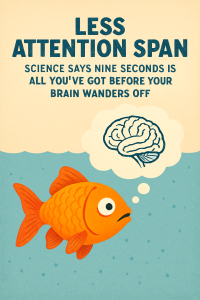
You have less attention span than a goldfish. Science says nine seconds is all you've got before your brain wanders off.
Now imagine trying to teach chemistry to a classroom full of goldfish at 5 AM. Welcome to my world.
I teach virtual classes at 5 AM. You'd think students would be fresh and focused at that hour, right?
They wake up early specifically for this, knock out their learning before the chaos of the day begins. Then they move on to work, kids, that demanding boss, or whatever else life throws at them.
But lately, only half my class is actually paying attention. I find myself teaching the same lesson twice, explaining concepts over and over.

The Invisible War for Attention
We're all fighting an invisible war every single day. Our attention is under constant attack from a tsunami of distractions.
TikTok reels. Instagram notifications. WhatsApp groups pinging relentlessly. That overflowing email inbox.
Studies show that human attention spans have dropped below that of a goldfish. Nine seconds—that's all I've got.
If I don't capture my learners in the first five seconds, I've lost them completely. And honestly? That's terrifying for any teacher.
The culprits are obvious. Smartphones designed to be addictive, social media platforms engineered to keep us scrolling.
We've created an environment where sustained focus has become a rare luxury.
My Wake-Up Call
This week really drove it home. I taught a lesson, felt good about it, then asked some basic follow-up questions.
Half the class? Clueless.
They'd checked out mentally while I was mid-explanation. That's when I realized: I need to completely change how I teach.
From Passive to Active: My New Strategy
The old model isn't working. Me talking, them listening—that's passive learning, and passive learning is dead in the age of TikTok.
I need active learning where their brains are constantly engaged. Here's what I'm trying:
- Pre-assignments paired with group work. Instead of lecturing, I assign reading or research beforehand. Then in class, students work in pairs to discuss and present what they found.
- Note-taking during lessons. When students write notes while I illustrate concepts, they stay locked in. Their hands are moving, their brains are processing.
- Breaking content into bite-sized chunks. No more hour-long lectures. Small, manageable pieces with breaks in between.
- Student presentations. Let them teach each other. Keep everyone alert because they know they might be called on next.
The Bottom Line
Those first five seconds matter more than ever. If I don't hook them immediately, I've lost the battle for their attention.
So I'm changing my approach. Less talking at them, more making them active participants in their own learning.
Because in this digital age, attention isn't freely given anymore. It has to be earned, constantly, every single day.