
Learning chemistry as an adult can feel overwhelming. Between work, family, and daily responsibilities, who has time to memorize 20 elements, their symbols, groups, and periods? Add electronic configurations to the mix, and it's enough to make anyone's head spin.
I discovered this firsthand when teaching a chemistry class. Half my students simply couldn't keep up. Their working memory was already packed with countless other things, and cramming chemical elements felt like an impossible task.
That's when I had a breakthrough: What if we turned learning into something fun?
The Magic Song
Instead of forcing my students to memorize, I created a simple song that makes the first 20 elements stick like magic:
"Hi, Hey Listen B B C News On Friday Night, Some Men Are Seen Pouring Some Chemicals Around Peter's Compound."
Here's how it works:
| Element | Symbol | Word in Song | |
| 1. | Hydrogen | H | Hi |
| 2. | Helium | He | Hey |
| 3. | Lithium | Li | Listen |
| 4. | Beryllium | Be | B |
| 5. | Boron | B | B |
| 6. | Carbon | C | C |
| 7. | Nitrogen | N | News |
| 8. | Oxygen | O | On |
| 9. | Florine | F | Friday |
| 10. | Neon | Ne | Night |
| 11. | Sodium | Na | Some |
| 12. | Magnisium | Mg | Men |
| 13. | Alminium | Al | Are |
| 14. | Silcon | Si | Seen |
| 15. | Phosporous | P | Pouring |
| 16. | Sulphur | S | Some |
| 17. | Chlorine | Cl | Chemicals |
| 18. | Argon | Ar | Around |
| 19. | Potassioum | K | Peters |
| 20. | Calcium | Ca | Compound |
Why It Works
The song turned memorization into play. Students recited it together, practiced with peers, and actually enjoyed learning. Suddenly, everyone knew which element came next without struggling.
Understanding Groups and Periods
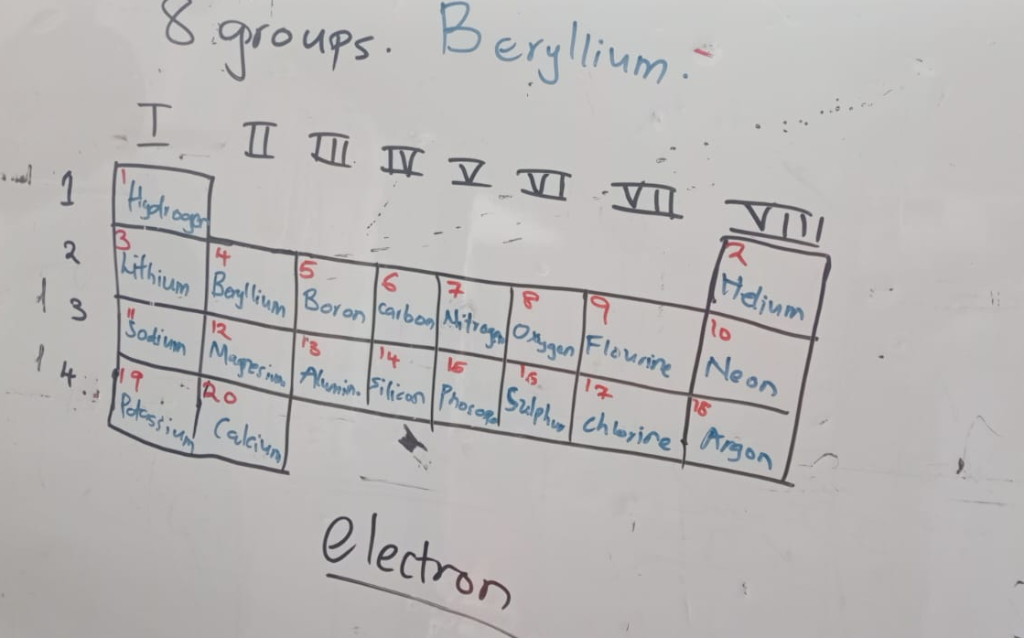
Once students mastered the song, understanding the structure became easier:
Periods (rows) tell you the number of energy levels:
- Period 1 = 1 energy level
- Period 2 = 2 energy levels
- Period 3 = 3 energy levels
- Period 4 = 4 energy levels
Groups (columns) show electrons in the outermost energy level:
- Group I = 1 electron in the last shell
- Group II = 2 electrons in the last shell
- And so on, up to Group VIII with 8 electrons
Elements in the same group share similar properties because they have the same number of outer electrons.
The Result
This simple song transformed my chemistry class. Learning became fun instead of frustrating. Students moved from cramming to understanding, building a solid foundation for everything that followed.
Sometimes the best teaching tool isn't a textbook—it's a catchy tune that turns a daunting task into something students actually look forward to learning.
Have you tried teaching with songs or mnemonics? What creative methods work for your students?